Now that he's governor of Nigeria's Kaduna State, Mallam Nasir Ahmad El-Rufai, the former chief administrator of Abuja, is leading a drive against street vendors.
So far, the vendors are bravely resisting, reports The Daily Independent.
As Mansur Abdulhamid, a young Kaduna vendor, tells the paper, "Will driving away traders from the streets solve the security and
economic situation in the state? Look at me, I have to hustle daily to
meet with demands at home from my aged parents, rent and feeding and
this include saving something little for my education."
The governor must know that street vending and hawking and other System D activities are the dominant way that people in all over Nigeria survive. It has been estimated that more than two-thirds of the working-age people in Nigeria earn their money off the books. That makes System D the majority economy. It's time for politicians to understand that, if they outlaw street trading, they make criminals of most citizens.

Saturday, July 18, 2015


Wednesday, July 15, 2015
Will those who know the truth about the Ladipo demolition please tell us
Something happened at 5,000-merchant-strong Ladipo Market, Lagos, Nigeria's famed auto spare parts mall, a few weeks back. But exactly what is hard to tell from afar.
On July 1, newspapers reported that the local and state governments had, without warning, moved in to demolish the market. The following day, government officials denied that story, suggesting that they were working on a redevelopment plan to improve the streets in the market.
Two days after that, traders totaled their losses at 100 million naira - or around half a million US dollars. They argued that government thugs, working with the police, had looted their products. Some observers suggested that the state government was engaging in a political vendetta against market leaders who had supported a rival party. Others argued that this was a tribal clash.
A few days later, the dispute was still festering. And at the start of this week, the market association hired a lawyer, presumably to advance their case in court and to lobby for them with the government.
I have seen a number of photos purporting to show the demolition, but none of them have shown the extent of the action.
So will someone who knows what really is going on please explain...
On July 1, newspapers reported that the local and state governments had, without warning, moved in to demolish the market. The following day, government officials denied that story, suggesting that they were working on a redevelopment plan to improve the streets in the market.
Two days after that, traders totaled their losses at 100 million naira - or around half a million US dollars. They argued that government thugs, working with the police, had looted their products. Some observers suggested that the state government was engaging in a political vendetta against market leaders who had supported a rival party. Others argued that this was a tribal clash.
A few days later, the dispute was still festering. And at the start of this week, the market association hired a lawyer, presumably to advance their case in court and to lobby for them with the government.
I have seen a number of photos purporting to show the demolition, but none of them have shown the extent of the action.
So will someone who knows what really is going on please explain...
Friday, October 17, 2014
home loans for System D!
Now here's a great thought: home mortgages for the vast numbers of people in System D. Caroline Wangui Kariuki, managing director of The Mortgage Company in Kenya, made the suggestion in an interview with the women's section of Standard Digital. Money quote:
“The pay slip and its contents determine if you will own a house or not. That is very unfair to the millions in the informal sector with fluctuating earnings. There must be a way of harnessing their earnings through a mortgage tailored to their circumstances,” she says.
According to Caroline, the Government as well as financial institutions fear the risks associated with this group, especially because cannot be assessed in terms of along term income.
This, she says, is a shallow way of looking at this category. There are precedents showing how the micro- finance sector has harnessed the small earnings in the informal sector to boost their financial base.
“If banks such as Equity have found ways of assessing the risks associated with banking the informal sector, surely they can come up with ingenious ways of financing the home market using the same principles,” she says.
Exactly! And not just in Kenya. All over the world. The global majority works off the books. Banks are more than willing to take their deposits but won't give them loans.
Suggestion to System D workers: don't put your money in a bank that won't work with you.
“The pay slip and its contents determine if you will own a house or not. That is very unfair to the millions in the informal sector with fluctuating earnings. There must be a way of harnessing their earnings through a mortgage tailored to their circumstances,” she says.
According to Caroline, the Government as well as financial institutions fear the risks associated with this group, especially because cannot be assessed in terms of along term income.
This, she says, is a shallow way of looking at this category. There are precedents showing how the micro- finance sector has harnessed the small earnings in the informal sector to boost their financial base.
“If banks such as Equity have found ways of assessing the risks associated with banking the informal sector, surely they can come up with ingenious ways of financing the home market using the same principles,” she says.
Exactly! And not just in Kenya. All over the world. The global majority works off the books. Banks are more than willing to take their deposits but won't give them loans.
Suggestion to System D workers: don't put your money in a bank that won't work with you.
Wednesday, June 11, 2014
what's a little irrationality among friends?
An interesting essay about Pakistan's near-total informality, from Harris Khalique. Money quote:
Some friends celebrate the informal and underground economy. Maybe they are right to the extent that the poor are at least able to survive as formal institutional arrangements of our national economy are not only limited, they are also exclusionary and pro-rich. But who is actually making the real buck from the informal economy? The same idle rich class, isn’t it? This class absolves itself of any duty of care for its workers when economic activity takes place in the informal sector.True. The rich have a way of profiting from every kind of economic relationship. But there's nothing less devious or more caring about the formal economy. Being part of the formal economy doesn't automatically mean owners feel a 'duty of care' for those laboring under them. And, indeed, formalization often takes away some elements of control that workers in System D have over their labor and their lives. Things that are irrational and inefficient in economic terms can also be positive and creative in social and political terms.
Wednesday, April 30, 2014
Kenya's essential economic engine

Government statistics show that Kenya created 724,800 new jobs last year.
- 26,300 were government jobs
- 89,700 in the private sector
- 626,800 in System D
Meaning that 86.5 percent of the new jobs in the East African nation were off-the-books and informal. That's some economic engine.
As the Standard says, "Despite being essential in employment creation, the informal sector has largely operated with little support from the government, which to a large extent failed to offer a conducive environment."
Tuesday, April 29, 2014
Brazil wages war against 20% of its population

What would you feel if a major sporting event came to your city and, in preparation, the police moved tanks and guys with assault weapons in front of your home?
Yes, the drug gangs are heavily rooted in the favelas. But they are an opportunistic infection. They made merry in the self-built squatter areas because the government pretended those communities didn't exist and treated all the people there as lower than 2nd class citizens. The police are not people's friends. In my time in Rio -- a dozen years ago now -- I was only harassed or threatened with guns by the cops. The police represent an alien unwanted occupying force doing no one no good.
Even calling this program pacification is sick. There's obviously nothing peaceful about it.
Monday, April 21, 2014
everything from self-development; nothing from the government
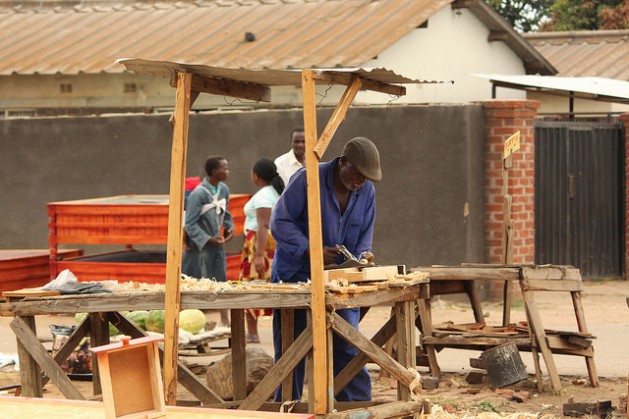
In Harare, there are now 18,500 people working in informal carpentry, up from 7,000 five years ago. During the same time period, formal carpentry jobs fell by almost the same amount, declining from from 22,000 to 13,000.
Conclusion: the jobs have moved off the books. As Tracy Chikwari, a 36-year-old single mother and System D entrepreneur told the news service, "I bought two houses here in Harare by trading in furniture that I guy from the informal market and I have no doubt this feat is taking me to greater heights."
An anonymous official complained to IPS that the carpentry business is so strong that the government is losing $32 million a month in unpaid taxes. But, as one sensible carpenter noted, taxation is a social contract: "Paying the government tax for our activities depends on what we also get from them. But we are getting nothing."
Monday, March 24, 2014
a little 'urban disorder' among friends
This article, from the Cameroon Tribune, unfortunately demonstrates the insanity and inanity of most writing about System D.
As a symptom of persistent "urban disorder," the newspaper in the Cameroonian capital presents this scenario: "It's 10 am and the weather is bright. Pauline Mangne, 27, a Yaounde inhabitant who works as a housemaid, was seen buying some food items in a small market or 'petit marcher.'"
The article continues: "A market normally is constructed and well planned in any city. But that is not the case in Yaounde. These unplanned markets are found mostly in main junctions, entrance into some schools and institutions of higher learning, financial institutions and beside motor parks. The items that are commonly sold in these markets are vegetables, fruits, palm nuts and maize among other perishable foods." Martine Messina, a roadside merchant who journeys from her farm to the city and back every day, told the paper, "Anything I harvest in the farm I come and sell in Yaounde." She insisted that it was the only way for her family to survive.
It's astonishing to read articles that assert that a farmer selling produce at the side of the road is pernicious. Just what is so disgraceful about a farmers market?
No matter where you go in Africa and Asia and South and Central America, city-built markets don't work for small-scale merchants and farmers. The obvious conclusion: the planners who keep planning these unsuccessful markets are wrong. And the folks who sell at the side of the road are right. Let's hear it for a little 'urban disorder' among friends.
As a symptom of persistent "urban disorder," the newspaper in the Cameroonian capital presents this scenario: "It's 10 am and the weather is bright. Pauline Mangne, 27, a Yaounde inhabitant who works as a housemaid, was seen buying some food items in a small market or 'petit marcher.'"
The article continues: "A market normally is constructed and well planned in any city. But that is not the case in Yaounde. These unplanned markets are found mostly in main junctions, entrance into some schools and institutions of higher learning, financial institutions and beside motor parks. The items that are commonly sold in these markets are vegetables, fruits, palm nuts and maize among other perishable foods." Martine Messina, a roadside merchant who journeys from her farm to the city and back every day, told the paper, "Anything I harvest in the farm I come and sell in Yaounde." She insisted that it was the only way for her family to survive.
It's astonishing to read articles that assert that a farmer selling produce at the side of the road is pernicious. Just what is so disgraceful about a farmers market?
No matter where you go in Africa and Asia and South and Central America, city-built markets don't work for small-scale merchants and farmers. The obvious conclusion: the planners who keep planning these unsuccessful markets are wrong. And the folks who sell at the side of the road are right. Let's hear it for a little 'urban disorder' among friends.
Wednesday, March 12, 2014
are street vendors terrorists?

“There is a confirmed relationship between smuggling and terrorism,” Ben Nasser told the paper, arguing that militants offer the smugglers protection, sometimes in the form of extortion, in addition to demand for their supplies, while smugglers provide food, equipment, untraceable cash and knowledge of unguarded routes in the country’s interior and across borders. “Militants and smugglers have shared interests."
But, at a conference at Stanford ten days ago, a respected security analyst came to the exact opposite conclusion. I asked Niklas Swanström, head of the Institute for Security and Development Policy, who spends a lot of time in criminal havens like North Korea, Tajikistan, and Dagestan and is an expert in transnational crime, about this exact issue.
He insisted that most smugglers and informal wholesalers and retailers don't need or want to work with terrorists. He said that, by their nature, terrorist organizations are slow and cumbersome -- more worried about ideology and furtive spycraft than rapid action. Smugglers, by contrast, have little use for ideology. They simply need to move their goods -- and getting in bed with terrorist networks doesn't make good business sense.
Tuesday, January 7, 2014
the tshukudeur

"I make sure to bring home the basic necessities: flour for the fufu [cassava paste], cooking oil and salt. If I have some money left, we feast on tomato sauce or meat," he tells Radio Netherlands (via allAfrica).
Being a tshukudeur is incredibly taxing work -- requiring brawn and energy. And his work has been made harder by the rebellion and conflict in that region of the DRC.
Two caveats about this report, though:
first, I cringe when any reporter, no matter how sympathetic, says, "Riding his large wooden bicycle, Biamungu, with his muscular, sweaty body, looks like a character from a novel."
second, in many African countries, fufu, sometimes called garri, is the staple food. I ate vast quantities of it every day in Nigeria. When I was in Kenya, I ate massive amounts of ugali -- a similar starchy sponge concoction made with corn. Though I am sure Biamungu's family's limited diet is nutritionally lacking (I most often had some vegetable stew and a small piece of boiled meat with my plate of fufu), a messload of starch and carbs was, to me, the perfect way to eat in that climate.
the street market of life
Juan Goytisolo's novel Makbara, which starts in the 'self-confident Eurocraticonsuming city' of the West, culminates in an appreciation of its Hegelian antithesis--the street market (his real-life model is Jemaa el-Fnaa, in his adopted hometown, Marrakesh):

'an agora, a theatrical performance, a point of convergence: an open and plural space, a vast common of ideas
peasants, shepherds, soldiers, tradesmen, hucksters who have flocked to it from the bus terminals, the taxi stands, the street stops of the jitneys poking drowsily along: coalesced into an idle mass'
 'offerings on the open market, within reach of anyone willing or able to give value for value received: far from the irreducible molecular order of the great industrialized European city: the hostility of the clock, the pressure of time, rush hours, infinite loneliness shared bumper to bumper'
'creating structures to welcome the world-wanderer'
 'survival of the nomad ideal as a utopia: a universe without a government or a leader, the free circulation of person and goods, land owned and used in common, the tending of flocks, sheer centrifugal force: the abolition of private property and hierarchy, of rigid spatial boundaries, of domination based on sex and age, of the ugly accumulation of wealth: emulating the fruitful freedom of the gypsy who respects no frontiers: encamping in a vast present of quests and adventure....a calligraphy that over the years is erased and then retraced day after day'
Here, in the gaudy market, his omniversal unipresent characters find a 'tiny little island of freedom and rejoicing in an ocean of wickedness and misery, giving them and giving myself the necessary strength to complete the day's journey, to gather up our belongings and prepare to move on, to seek shelter, to lull ourselves to sleep with the idea that tomorrow everything will be better and they will still be with you, as will I, all ready to invent new and even more marvelous adventures, finding a welcome refuge, if it be God's will, in the free and easy, kindly tolerance of the public square'
This is, of course, the endless presence, the eternal now--duplicitous and dramatic, monotonous and unique, shared and solitary, everything and nothing
The street market of life
'an agora, a theatrical performance, a point of convergence: an open and plural space, a vast common of ideas
peasants, shepherds, soldiers, tradesmen, hucksters who have flocked to it from the bus terminals, the taxi stands, the street stops of the jitneys poking drowsily along: coalesced into an idle mass'
'creating structures to welcome the world-wanderer'
Here, in the gaudy market, his omniversal unipresent characters find a 'tiny little island of freedom and rejoicing in an ocean of wickedness and misery, giving them and giving myself the necessary strength to complete the day's journey, to gather up our belongings and prepare to move on, to seek shelter, to lull ourselves to sleep with the idea that tomorrow everything will be better and they will still be with you, as will I, all ready to invent new and even more marvelous adventures, finding a welcome refuge, if it be God's will, in the free and easy, kindly tolerance of the public square'
This is, of course, the endless presence, the eternal now--duplicitous and dramatic, monotonous and unique, shared and solitary, everything and nothing
The street market of life
Thursday, January 2, 2014
Against Economics
Andro Linklater’s latest and, sadly, last book (he died as
it was being published) started as his attempt to make sense of the global
economic crash and mutated into a paean to the potential and problems inherent
in private property.
He knew this was an extraordinarily old-fashioned approach to
modern fiscal analysis. But, as he writes toward the outset of Owning the Earth, “The idea of
individual, exclusive ownership, not just of what can be carried and occupied,
but of the immovable, near-eternal earth, has proved to be the most destructive
and creative cultural force in written history. It has eliminated ancient
civilizations wherever it has encountered them, and displaced entire peoples
from their homelands, but it has also spread an undreamed-of degree of
personal freedom and protected it with democratic institutions wherever it has
taken hold.”
This shouldn’t give you the idea that Owning the Earth is a heartless, self-congratulatory free-market
screed. Rather, Linklater’s villains are the Austrian School (those two
patricians, Ludwig von Mises and Friedrich Hayek, in particular) and all those
who confuse the production of individual wealth with democracy and the
promotion of purely private interests with the public good. “The iron law of
private property,” he concludes, “turns out to be a paradox. Although it
promotes individuality, it only works by giving equal weight to the public
interest.” His heroes, then, include Adam Smith (not for the “invisible hand”
but for its corollary: the idea that the market is designed and tempered to the
public interest), James Madison (for having “embraced the diversity of opinion
as evidence of free society”) and Wolf Ladejinsky (who pioneered land
redistribution while working for Douglas MacArthur in the 40s and early 50s.)
Linklater romps through history with the insouciance of
Minnesota Fats attempting a five-ball bank-shot combination to either beat or
sucker a pool hall opponent. The book hopscotches centuries and continents and moves
from the Levelers to Lehman Brothers, with Locke, Lenin, Lincoln, Ladejinsky, Linux, and
the Louisiana Purchase in between. He concludes that private property promotes democracy – but only when it’s an expanding resource, available to all,
cheaply and efficiently. Once the frontier closes or is disposed of (or, in global intellectual property agreements, if patents held privately are given the force of law while varieties of communal ownership are not) the egalitarian and equitable teamwork between property and democracy breaks down.
His assertion that the massive government-led rescue plans developed after the recent financial meltdown proved that "the Austrian experiment had failed" may be an overstatement--after all, free market absolutists are still vocal, almost everywhere. But Linklater is more interested in small futures than big ones. As he notes, rivalries over land and resources may create vicious conflicts, but don’t always cause the many types of legal
and quasi-legal sharing arrangements to rupture. “Even three wars between India
and Pakistan have not caused either of them to break the Indus Water Treaty
they signed in 1960. Underpinning these formal regulations for sharing water,
as well as thousands of other informal arrangements, has been the understanding
that it is worth limiting individual needs so that everyone benefits from a
limited resource. However bitter the disputes, it is overshadowed [grammatical oddity in the original] by the
realization that taking whatever one wants risks destroying the entire system
and ruining everyone.”
Owning the Earth flips traditional
pieties about property on their head. Linklater doesn’t cite Peter Kropotkin or Karl Polanyi or E.F.Schumacher or Elinor Ostrom – but his work is imbued with their spirit.
“There is an alternative to the single, ultimately unviable measure
of success imposed by economics,” Linklater concludes. “Around the world and
throughout history, neighborhoods have succeeded in a million different ways.”
Yes!
***
one querulous cavil: Oddly, Owning the Earth contains some grammatically questionable constructions and lots of oddball spellings (among them: Hayek is "Friederich" instead of Friedrich, the Chinese city Shenzhen is "Zhenzhen," Mao Zedong is spelled "Zhedong" on first reference, and George H.W. Bush is referred to as "George H. Bush.") Misspellings can creep into any volume, but these seem egregious.
Monday, December 23, 2013
danger: flea markets ahead

Rote Flora, a half-destroyed theater built in 1888, was legally leased by left-wing squatters in 1989 and turned into a cultural center that regularly organizes parties and flea markets.
The police action came after protests sparked by the threat of eviction after the city sold the site to a developer. Residents also demonstrated against forced evictions in the Reeperbahn red-light district and demanded better rights for refugees.
It's amazingly two-faced. Western democracies are outraged when authorities claimp down on freedom of assembly and expression in places like Tahrir Square, but engage in military-style repressive clamp-downs on their home turf.
Friday, December 20, 2013
The fault, dear Brutus ...
... is not in our stars, but in ourselves.
Grand rhetoric courtesy of William Shakespeare. But not a particularly ringing endorsement of the possibility of social change.
Which is why Roger Cohen's heartfelt column in the international edition of the NYT seems oddly bloodless. He's right in his diagnosis: inequality is a massive problem -- in India and throughout the world. 'When a phrase like “the bottom 90 percent” [or, I might add, 'we are the 99 percent'] rolls off the tongue as if this were a normal state of affairs,' he writes, 'something is amiss.'
But what's his prognosis? Only that nugget from Shakespeare. "Policy change can help," he writes in his last sentence, but the real change "must come from within each of us."
Well, sure. Duties and obligations, as Simone Weil wrote decades ago, come before rights.
Indeed, to look at the full quote from Shakespeare (full text of the play here), reveals that the Bard was not making a plea for inward inquiry but rather one for revolution: 'The fault, dear Brutus, is not in our stars but in ourselves, that we are underlings.' Cassius, who speaks this line, wants Brutus to join a bloody plot to oust the current leader, Julius Caesar, and seize power.
Grand rhetoric courtesy of William Shakespeare. But not a particularly ringing endorsement of the possibility of social change.
Which is why Roger Cohen's heartfelt column in the international edition of the NYT seems oddly bloodless. He's right in his diagnosis: inequality is a massive problem -- in India and throughout the world. 'When a phrase like “the bottom 90 percent” [or, I might add, 'we are the 99 percent'] rolls off the tongue as if this were a normal state of affairs,' he writes, 'something is amiss.'
But what's his prognosis? Only that nugget from Shakespeare. "Policy change can help," he writes in his last sentence, but the real change "must come from within each of us."
Well, sure. Duties and obligations, as Simone Weil wrote decades ago, come before rights.
Indeed, to look at the full quote from Shakespeare (full text of the play here), reveals that the Bard was not making a plea for inward inquiry but rather one for revolution: 'The fault, dear Brutus, is not in our stars but in ourselves, that we are underlings.' Cassius, who speaks this line, wants Brutus to join a bloody plot to oust the current leader, Julius Caesar, and seize power.
Yes, as Cohen notes, the system is rigged and "the common man and woman have been had." But individualism -- a.k.a. the profit motive -- got us into this mess. Individualism -- a.k.a. charity, or, in Cassius's and Brutus's case, the desire for power and fame -- is not what's going to dig us out.
There are lots of things groups can do collectively to promote change and reduce inequality. Here's one place to start: the mass of people -- the squatters and System D merchants who are actually the bedrock of every city in every developing world country -- need to organize and empower themselves. Their self-mobilized, self-governing groupings will lead the way to development that is more democratic and egalitarian.
As Nobel-prize-winner Elinor Ostrom wrote in a paper that's as relevant today as it was when it was written in 1994, "we will all be the poorer if local, self-organized institutions are not a substantial portion of the institutional portfolio of the 21st century."
tip o' the hat to Jacqueline Novogratz, a.k.a. @jnovogratz, for the link to the Roger Cohen article.
Wednesday, December 11, 2013
aid, trade, and criminality
It all sounds super-nefarious: Global Financial Integrity, a Washington-based non-profit, reports that developing countries across the globe lost almost $1 trillion from illicit financial flows in 2011. Sub-Saharan Africa--a region that needs all the money it can get--lost $52 billion in 2011, the equivalent of 5.7 percent of total Gross Domestic Product drained from the region's economies. Leading the list of the porous states on the continent: Nigeria, which lost $142.3 billion between 2002 and 2011.
So who are these criminals who are bleeding developing countries dry? It ain't terrorists or criminal cartels. Rather, the criminal enterprises at the root of this are mostly respected multinational corporations.
Though transfers from criminal cartels and terrorist organisations are a problem, the report concluded that the majority of this illegal financial activity stems from misleading and discounted trade invoices filed by international corporations.
And here's an amazing stat: this corporate malfeasance amounted to ten times the total value the developing world received in aid. Think about that the next time you consider the aid vs. trade question.
So who are these criminals who are bleeding developing countries dry? It ain't terrorists or criminal cartels. Rather, the criminal enterprises at the root of this are mostly respected multinational corporations.
Though transfers from criminal cartels and terrorist organisations are a problem, the report concluded that the majority of this illegal financial activity stems from misleading and discounted trade invoices filed by international corporations.
And here's an amazing stat: this corporate malfeasance amounted to ten times the total value the developing world received in aid. Think about that the next time you consider the aid vs. trade question.
Tuesday, November 19, 2013
Jo-burg jive
Johannesburg is going after street hawkers, as this article reports. But note the language: Who can be against 'clean up' and 'order.' Meanwhile the municipality is putting thousands of families in jeopardy and crushing the traditional life of the city.
ht wiego
ht wiego
Thursday, November 7, 2013
economic inspiration
What gives its special quality and character, its toughness and cohesion, to the industrial system built up in the last century and a-half, is not its exploded theory of economic harmonies. It is the doctrine that economic rights are anterior to, and independent of, economic functions.
--R.H. Tawney
The fact that two people exchange their products is by no means simply an economic fact. Such a fact -- that is, one whose content would be exhausted in the image that economics presents of it -- does not exist.
--Georg Simmel
Wealth is like muck. It is not good but it be spread.
--Francis Bacon
I do not deny that modern economic theory can make a contribution to running a household, or a village, or a region, or even the entire world -- though such a denial would at all be unrealistic. What I do deny is that modern economic theory can replace the traditional ways without any loss of information or quality of life.
--Paul Feyerabend
Nothing, however profitable, goes on forever.
--C.L.R. James
Between things there exist bonds of mutual aid hampered by man.
--Martín Adán
No man can save himself alone.
--Simone de Beauvoir
Friday, November 1, 2013
the living part of the culture
Politics always puts forward Ideas: Nation, Empire, Union, Economy, etc. But none of these forms has value in itself; it has it only insofar as it involves concrete individuals. If a nation can assert itself proudly only to the detriment of its members, if a union can be created only to the detriment of those it is trying to unite, the nation or the union must be rejected.
--Simone de Beauvoir, The Ethics of Ambiguity
And, I would add, if an economy can assert itself only to the detriment of the whole of the society it is designed to assist, that economy must be rejected.
The philosopher Paul Feyerabend identified the problem in his agreeably anarchic book Against Method (excerpt here):
People all over the world have developed ways of surviving in partly dangerous, party agreeable surroundings.The stories they told and the activities they engaged in enriched their lives, protected them and gave them meaning. The 'progress of knowledge and civilization' -- as the process of pushing Western ways and values into all corners of the globe is being called -- destroyed these wonderful products of human ingenuity and compassion without a single glance in their direction.Indeed, it seems to me that our economic goals should be retooled along the lines of what Charles Newman identified in his posthumously published novel, In Partial Disgrace: "to extract money from the real economy and cheerfully redistribute it into the inefficient, living part of the culture."
Monday, October 28, 2013
the impeccable logic of development ...
... comes at the very end of this article on India's huge informal economy from The Hindu. Given the continued growth of System D in India, even in an era of unprecedented total economic growth,
After all that's been written about informality in the four decades since Keith Hart coined the term in 1973, shouldn't this be the start of any analysis rather than the tentative conclusion.It must be the case that there are many areas where the informal sector is not only not in competition with the formal sector, but actually services its requirements....In the process low wages in the informal economy help sustain profits in the formal sector. Only when this possibility is taken into account can we explain the size and scope of India’s informal economy.
Sunday, October 20, 2013
the media menace

This editorial attitude is typical of much of the news coverage of street hawkers in India. The photo suggests that there are more shoppers at this bustling transit transfer point than there are merchants -- but nonetheless, the dominant narrative is that the merchants constitute a 'menace.'
The bias exhibited by newspapers and media outlets is the real menace.
Street hawkers naturally gravitate to locations where shoppers are. That's not a menace. Indeed, you might argue it's a public service.
Subscribe to:
Posts (Atom)