What a great idea.
AllAfrica offers news of a new plan in Ghana that offers savings and pensions for informal merchants. The plan launched as a pilot in 2005 and now has 40,000 members. Contributors are given a pass book. Half their contributions are held to provide pensions while the remaining 50 per cent can be used as a bank account from which the contributor can make withdrawals.
Officials estimate that 600,000 people in Ghana could join in the coming five years. This hybrid approach, recognizing the need for retirement money and the need to reinvest in businesses might have legs!

Tuesday, July 28, 2009


informal in Angola
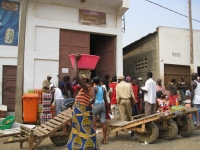
Angola's informal economy--street vendors selling everything from car stereo parts and locally-caught fish to fake perfume and Chinese flip flops--in markets like Roque Santeiro, which was founded in 1986, are now threatened by a ban on street trading. Inter Press Service has details.
Among the interesting facts in the article:
* Angola has a very high rate of entrepreneurship. One in four Angolans were involved in start-ups, significantly higher than other production-driven economies, like India and Colombia.
* an NGO formerly called the Sustainable Livelihoods Project (it's now known as KikiCredito) tried to replicate in Luanda the work that was pioneered by Grameen bank in Bangladesh. The project organized groups of 20 to 30 merchants with democratically-elected officials. In 2004, SLP had nearly 5,000 clients in Luanda and a second city, Huambo, and the project was hailed as a first-rate example of a successful micro-finance initiative.
* Out on Luanda's streets, however, at the bottom rung of the entrepreneurial ladder, life is harder than ever, thanks to the provincial government's new ban on street vendors. Teams of police patrol the crumbling pavements, chasing women from their patches, sometimes seizing their precious goods. The legislation was introduced to "clean up" Luanda and concentrate sellers in designated market areas like Roque Santeiro.
It remains a mystery why governments are determined to stamp out informal entrepreneurship when their countries clearly have so many other social and environmental problems to confront.
Thursday, July 9, 2009
Ghana's most irreverent!

Ato Kwamena Dadzie, a journalist who bills himself as "Ghana's most irreverent," has a great take on the effort by Alfred Vanderpuije, Accra's new mayor, to drive hawkers out of center of the city. Money quote:
Let’s face it. The central business district of Accra is a commercial centre. The whole area is one big market and like every market we should expect the area to be a congested beehive of economic activity. Most African markets are like that. We’ve lived with it for decades and it’s hard to see why the mayor wants to change it.
These hawkers are on the streets because they need to survive. Government should be looking for ways to help their small businesses thrive instead of hounding them with batons, destroying their stalls and breaking their wares.
6,000 traders at risk
Destruction of the Warwick Early Morning Market in Durban, South Africa threatens 6,000 traders who together earn 1 billion rand, or about $123 million. Business Day has details.
PS: Sorry for the gap in my blogging. I spent the past few weeks myopically focused on completing a manuscript. Slow suffocation by paper. But I am still breathing and should have more time to post regularly now.
PS: Sorry for the gap in my blogging. I spent the past few weeks myopically focused on completing a manuscript. Slow suffocation by paper. But I am still breathing and should have more time to post regularly now.
Monday, June 8, 2009
raiding fela 32 years on
The Lagos State government has been busy bashing away at street hawkers and street markets. Now it has closed up the Africa Shrine, the famous music hall run by Femi and Yeni Kuti, children of famed Afro-beat innovator Fela Kuti. The Independent has details.
Fela's original Africa Shrine was shut by the military in 1977, and Fela himself was "dragged from the building by his genitals." Soldiers threw Fela's mother out the window, and she died from her injuries. Now, 32 years later, a democratic regime has closed the rebuilt club.
I know: it's a club. It's noisy and attracts marijuana smokers (Fela was big on that) and stays open till early morning. Still, it is one of the great attractions of Lagos.
People salute Governor Babatunde Fashola for being a man of action, but from the outside (I haven't been back to Lagos in six months), it seems like he's taken Imperial powers to new heights. And he certainly doesn't understand the importance of the informal economy to his city's survival--and the creative possibilities for harnessing it to create a truly African urbanism.
Oh, and due process? I guess Gov. Fashola, who was trained as a lawyer, simply doesn't believe in it.
Fela's original Africa Shrine was shut by the military in 1977, and Fela himself was "dragged from the building by his genitals." Soldiers threw Fela's mother out the window, and she died from her injuries. Now, 32 years later, a democratic regime has closed the rebuilt club.
I know: it's a club. It's noisy and attracts marijuana smokers (Fela was big on that) and stays open till early morning. Still, it is one of the great attractions of Lagos.
People salute Governor Babatunde Fashola for being a man of action, but from the outside (I haven't been back to Lagos in six months), it seems like he's taken Imperial powers to new heights. And he certainly doesn't understand the importance of the informal economy to his city's survival--and the creative possibilities for harnessing it to create a truly African urbanism.
Oh, and due process? I guess Gov. Fashola, who was trained as a lawyer, simply doesn't believe in it.
Thursday, May 14, 2009
glasgow kills paddy's market
The Glasgow city council has declared 200-year-old Paddy's Market a "crime-ridden midden" and announced a "new vision", which includes plans to revitalise the area and lease units to artists and "legitimate traders". Current residents have been given notice to vacate the site by tomorrow, reports UTV News.
The market, tucked under railway arches in a lane running between the city centre and the River Clyde, is unique and haphazard. Clothes, books and furniture are strewn along rickety tables and camp-beds. But Michael Burns, a fifth-generation hawker, says this is part of its appeal. "You cannot make this city all shiny and polished and pretend it's something that it's not. We serve a need. Paddy's is a reminder that poverty still exists here. Closing us might take the problem out of sight, but it doesn't solve it."
It's classic: despite the council's talk of renting the site to legitimate traders, the current occupants are legitimate, too. They pay £130,000 a year in rent, plus taxes.
Sounds like the Council thinks gentrified market sellers are more legit than the people who are there now.
The market, tucked under railway arches in a lane running between the city centre and the River Clyde, is unique and haphazard. Clothes, books and furniture are strewn along rickety tables and camp-beds. But Michael Burns, a fifth-generation hawker, says this is part of its appeal. "You cannot make this city all shiny and polished and pretend it's something that it's not. We serve a need. Paddy's is a reminder that poverty still exists here. Closing us might take the problem out of sight, but it doesn't solve it."
It's classic: despite the council's talk of renting the site to legitimate traders, the current occupants are legitimate, too. They pay £130,000 a year in rent, plus taxes.
Sounds like the Council thinks gentrified market sellers are more legit than the people who are there now.
Tuesday, May 12, 2009
more on the soccer war
I missed this when it came out--though I did post on a demonstration about the issue here.
Now it seems that Durban, South Africa not only wants to disrupt hawkers during the World Cup in 2010. It actually wants to turn informal markets into an upscale malls.
Inter Press Service reports on the plan that would uproot the 674 traders at the Warwick Junction Market and transform the space in the Warwick Junction Mall. All this for $2.5 million over 50 years.
In typical fashion, the government would earn almost triple that amount by working with the hawkers.
[thanks, Richard, for sending this my way]
Now it seems that Durban, South Africa not only wants to disrupt hawkers during the World Cup in 2010. It actually wants to turn informal markets into an upscale malls.
Inter Press Service reports on the plan that would uproot the 674 traders at the Warwick Junction Market and transform the space in the Warwick Junction Mall. All this for $2.5 million over 50 years.
In typical fashion, the government would earn almost triple that amount by working with the hawkers.
[thanks, Richard, for sending this my way]
Subscribe to:
Posts (Atom)