Friday, December 16, 2011

motherhood and apple pie and System D

Sub rosa schools, right here at home, in the most developed city in the developed world.

The New York Times reports on illegal cooperative preschools--formed by middle class parents who can't afford private schools and whose kids don't get included in the city-operated ones, because enrollment in pre-K classes is tightly limited. Soni Sangha writes:
In a co-op pre-K, parents work together to create a school that matches their educational philosophy and worldview. They also run it, finance it, staff it, clean it and administer it — whatever is necessary to keep costs as low as possible. Often, schools operate from members’ homes. Some are taught by parents; others by professional teachers. The downside to such an arrangement? It’s a lot of work. We had found that out last school year, when my son had been priced out of private options and we had banded together to form a co-op with some parents from the neighborhood.


Beyond the effort was the challenge of getting different families to work together. When matters as personal as education, values and children are at stake, intense emotions are sure to follow, whether the issue is snacks (organic or not?), paint (machine washable?) or what religious holidays, if any, to acknowledge. Oh, and in many cases, forming a co-op school is illegal, because getting the required permits and passing background checks can be so prohibitively expensive and time-consuming that most co-ops simply don’t.
 ....

In New York City, child care outside the home is overseen by the Department of Health and Mental Hygiene. The city requires a permit for any child-care setting where there are at least three children who are not each accompanied by a parent and who meet for more than five hours a week. Inside the home, the state’s Office of Children and Family Services oversees regulation for any group that meets for more than three hours a day. Getting a permit means red tape. Lots of it. There are background checks, required teaching certifications, written safety plans and site inspections.

I wouldn't label these families as crooks. I'd call what they're doing ingenious and enterprising self-help education.

temporary occupation, NYC, Dec. 17

Thursday, December 15, 2011

Monrovia criminalizes 2/3 of the population

Monrovia, the capital of Liberia, is the latest city to ban street hawking, the German Press Agency reports.

According to the UN's International Labour Organisation (ILO), about 68 per cent of employed Liberians work in the informal sector, including street sales. Indeed, when employment in the informal sector is taken into consideration, Liberia's unemployment rate is as low as 3.7 per cent. 

So that raises the question: why would officials move to criminalize the majority of the working population? Why criminalize the one part of the economy that actually keeps people working and surviving?

Wednesday, December 14, 2011

the canard

One of most common, and most misguided, arguments against System D, the informal economy, is that it evades laws and thus is a threat to public safety.

If anyone thinks criminality is confined to the global underground, read this Guardian piece about PIP, the fully formal and, until 2010, well-respected French company that made breast implants. Money quote:
The company Poly Implant Prosthesis (PIP), based in the south of France, was one of the world's leaders in silicone implant production until last year when it was found to have been cutting corners and saving an estimated €1bn (£840m) a year by using industrial silicone instead of medical-grade fillers in their breast implants. The casing around the filling was also faulty and prone to rupture or leakage. The company has closed and more than 2,000 women have filed legal complaints. A judicial investigation has begun for involuntary homicide over a woman who died from cancer.
Let's put it in bold in case it hasn't sunk in: a formal corporation is under investigation for committing homicide. 

The lesson: criminality exists. Nike's contractors hired child labor until advocacy groups revealed the practice. Siemens paid $1 million in bribes every business day in pursuit of contracts across the developing world. Fully formal firms commit crimes--crimes that harm and, in the extreme, kill.

I don't argue that underground economy is blameless. But let's not pretend formal businesses are clean.

death in florence

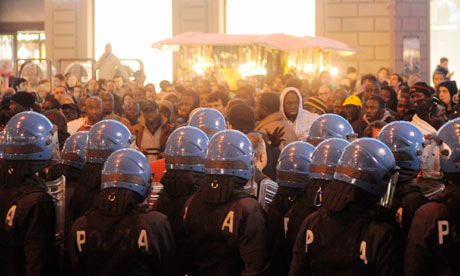
A 50-year-old Italian right-winger turned his .357 Magnum on the African vendors in the Piazza Dalmazia street market in Florence, killing two and wounding three others before shooting himself, the Corriere della Sera reports. In response, 300 mostly Senegalese peddlers massed in Piazza Duomo. One marcher told the Guardian, "Don't tell us he was a madman, because if he was he would have killed whites as well as blacks." The Italian far-right, anti-immigration organisation Casapound said on Tuesday that the shooter was a "sympathiser" who had frequented one of its centers in Tuscany, the Guardian added.

Tuesday, December 13, 2011

no beggar's banquet in Paris

French President Nicholas Sarkozy has decided to push beggars out of many fancy parts of Paris, the Guardian reports.

Sarkozy's interior minister and long-time right-hand man, Claude Guéant, has issued a series of decrees banning begging around Paris's most popular Christmas shopping and tourist spots. So now the Champs Elysées, and the areas around the Galeries Lafayette and Printemps department stores, and the Louvre and Tuileries Gardens, are off-limits to panhandlers.

Many of the 300 beggars who have been cited in court are Romanian, and, the Guardian notes, Guéant has hired 33 Romanian police officers to help the Paris force muscle the mendicants off the Champs Elyssés.

Begging may not be entrepreneurial behavior, but beggars do deserve to be treated with dignity. With this Marie Antoinette-style move, Sarkozy seems to be saying that it's a crime to be poor, desperate, and foreign-born.

Friday, December 9, 2011

Sao Paulo street vendors attacked

The Military Police moved in on 7,000 street vendors in the Bras neighborhood of Sao Paulo, destroying a market that has drawn as many as 30,000 people a day for the past eight years, Street Net reports. Bras is where many vendors from the downtown market on Rua 25 de Marco had fled after a similar police putsch there.

Leonardo Dunas, the Secretary General of the Union of Independent Street Vendors, noted that the breakup of the market was illegal under customary law, since the vendors have been operating with the tacit agreement of shot owners and the local government. In addition, Sao Paulo by-laws actually allow street vending.

“It seems there may be political interests at play.  There are plans to develop the area and build a hotel and commercial complex. Certainly, some investors might have the 2014 World Cup in mind, we don’t know”, Dunas said. “We are here to denounce policy brutality, to defend the right to work, and the rights of thousands of families who want to make an honest living.”

The eviction of the market in Bras occurred in late October. If anyone knows the situation on the ground now, please post updated details in the comments.