The Lagos State Government has decided to ban all street selling, effective immediately, The Vanguard reports.
"This administration is set to make the trade unprofitable, as both both the street traders and buyers will be prosecuted under this renewed policy," Commissioner for Environment Tunji Bello, told the paper.
It's a strange thing: the Lagos State Government seems to believe that street selling in the root of all evil." At the same time, the article notes, Commissioner Bello and others in power admit that people must trade to survive and make a living in Lagos.
The government seems to want to punish the people for being in need. This is very Victorian stuff and will help destroy the urban fabric of Lagos.

Tuesday, November 29, 2011


fake steve jobs bio
The pirated version of Walter Isaacson's Steve Jobs bio is a big hit in China, Eastday reports. Unfortunately, according to the article, some of these pirate editions may be fiction instead of fact: "Some pirated books' content is totally different from original book, despite an identical cover."
Monday, November 28, 2011
how to fight street crime
The lede from the Nairobi Star (via All Africa) says it all: "The informal sector is the best tool to fight crime and offer employment to the youth."
The other facet of the story that's interesting is that the Kenyan government is apparently offering low interest loans to informal firms through something called the Youth Fund -- at interest rates that are way better than the banks or microfinance groups. But "the funds are lying idle" --most likely because people are worried that the government will use the knowledge of their business to go after their assets.
Until May 2011, only youth groups could take advantage of the program. But now individual entrepreneurs can apply as well.
The other facet of the story that's interesting is that the Kenyan government is apparently offering low interest loans to informal firms through something called the Youth Fund -- at interest rates that are way better than the banks or microfinance groups. But "the funds are lying idle" --most likely because people are worried that the government will use the knowledge of their business to go after their assets.
Until May 2011, only youth groups could take advantage of the program. But now individual entrepreneurs can apply as well.
Thursday, November 17, 2011
a great idea or more hot air?
India is mulling how to provide social security benefits to its 430 million workers in System D, LiveMint reports. The government estimates that 94 percent of India's workforce is in the informal sector, and that they account for around 60% of India’s gross domestic product.
These ingenious entrepreneurs and street merchants are crucial to the nation's survival. But, as one economist notes in the article, India does not have a great track record in service delivery--and so the whole discussion might simply be an academic exercise or a ploy for the ruling Congress Party to win public support. “This is ambitious simply because we do not know how to implement it,” said S.L. Rao, Bangalore-based sociologist and former director general of the National Council for Applied Economic Research. “When we look at social security, we look at delivering services and money for taking care of health, education and insurance. To be honest, so far we have been incompetent in delivery of both services and money.”
These ingenious entrepreneurs and street merchants are crucial to the nation's survival. But, as one economist notes in the article, India does not have a great track record in service delivery--and so the whole discussion might simply be an academic exercise or a ploy for the ruling Congress Party to win public support. “This is ambitious simply because we do not know how to implement it,” said S.L. Rao, Bangalore-based sociologist and former director general of the National Council for Applied Economic Research. “When we look at social security, we look at delivering services and money for taking care of health, education and insurance. To be honest, so far we have been incompetent in delivery of both services and money.”

Wednesday, November 16, 2011
the mountains are high and the emperor is far away
Reason Magazine takes you to a Chinese System D boomtown: Wenzhou, where businesses have joined together to fund the city's infrastructure.
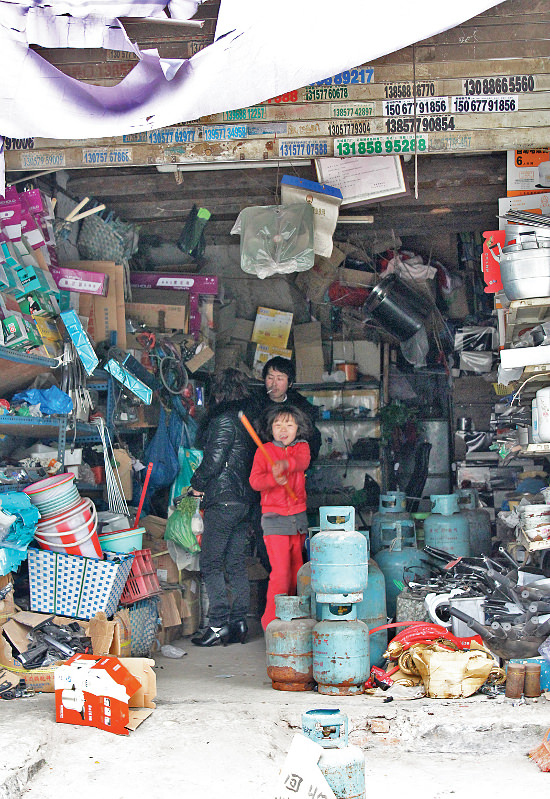
Wenzhou is a commercial powerhouse. Unlike Beijing and Shanghai, though, it's the informal entrepreneurs who have made Wenzhou flourish. Here's how the article sets the scene:


Hat tip to Zach for flinging this my way.
Wenzhou is a commercial powerhouse. Unlike Beijing and Shanghai, though, it's the informal entrepreneurs who have made Wenzhou flourish. Here's how the article sets the scene:
Private citizens were the first to connect Wenzhou to neighboring regions by building roads, bridges, and highways, as well as the city’s airports and substantial portions of the dock. Even today the city is scattered with infrastructure investment firms through which groups of businessmen pool money to build the transport routes they all need to get their goods from factory to the point of sale. The result is not pretty. Aside from the confusion faced even by residents driving into the city, it is not uncommon to see sidewalks torn up to insert piping, with seemingly no intention of replacing the concrete. Nevertheless, the system is crudely efficient, merchants can all easily access factories, and the factories in this geographically isolated city now have sales networks that span the globe. ... The streets around the railway station are covered in stalls selling $3 blue jeans and $5 boots. There’s a city block dedicated to baby clothes next to a street that sells plastic signs for bathroom doors. In one run-down alleyway you’ll see people repairing televisions, making blankets, and selling fruits, vegetables, and poultry (live or dead). Further outside the center, you can find small shops dedicated to aluminum rods, sheet metal, tire rims, and tires. ... Pool halls are set up wherever there’s open space that you can set a tarp over. Gambling dens are openly advertised. Taxi drivers often drive off the meter. The karaoke parlors are numerous, and almost all of them double as brothels. The poorest residents take part in one of the largest citizen recycling programs anywhere in the world. In an alley one family collects scraps of fabric to sell to the local textile mills, another hoards scraps of paper and cardboard to send to the paper mills, and in front of a lot that looks like it is being used for a garbage dump, a man has set up a secondhand goods shop.

Hat tip to Zach for flinging this my way.
you be the judge
Every time I get interviewed about Stealth of Nations and the global growth of System D, I get asked a variation of this question: "Aren't workers in the informal economy being exploited?
For all those who think the formal economy is so great for workers, check out this cringe-inducing article from The Guardian. The British paper discovered that the government is sending young unemployed people in the UK to work for major businesses, in what the government calls a work experience program. The catch: they have to work for free. If the unemployed people refuse to work for no pay, they risk losing their $80 per week unemployment stipends.
James Rayburn, a 21-year-old job-seeker, told the Guardian that, with his unpaid job at the supermarket chain Tesco, which earned a $6 billion profit last year, "it [was] as if I walked into the store and said, 'Look I'll help.'" Even if you want to consider his unemployment benefit a salary, if Rayburn worked 30 hours a week, his effective wage was $2.66 an hour.
So you be the judge. Which is more exploitative: System D--which actually pays its employees--or this scheme cooked up by the government and some supremely profitable businesses--which doesn't?
For all those who think the formal economy is so great for workers, check out this cringe-inducing article from The Guardian. The British paper discovered that the government is sending young unemployed people in the UK to work for major businesses, in what the government calls a work experience program. The catch: they have to work for free. If the unemployed people refuse to work for no pay, they risk losing their $80 per week unemployment stipends.
James Rayburn, a 21-year-old job-seeker, told the Guardian that, with his unpaid job at the supermarket chain Tesco, which earned a $6 billion profit last year, "it [was] as if I walked into the store and said, 'Look I'll help.'" Even if you want to consider his unemployment benefit a salary, if Rayburn worked 30 hours a week, his effective wage was $2.66 an hour.
So you be the judge. Which is more exploitative: System D--which actually pays its employees--or this scheme cooked up by the government and some supremely profitable businesses--which doesn't?
Subscribe to:
Posts (Atom)