This New York Times article offers a peep at an interesting and progressive program in New York. Rather than reporting unlicensed construction firms to the authorities, the Queens Economic Development Corporation is trying to help them out, teaching them the skills required to pass the licensing test for home improvement contractors given by the city's Department of Consumer Affairs. Interestingly, despite the size of the Chinese community in NYC and their involvement in real estate in many neighborhoods, the city only offers the 30-question multiple choice test in English, Spanish, Korean and Bengali.
This program is a great idea--giving previously illegal contractors a route to legality. But it also raises some issues about the licensing test. For instance, how important is it for contractors to know that, for jobs that cost less than $200, they don't need a license. Or that they must keep their contracts on file for 6 years. Or that they can't start work on a job until 3 days after they sign the contract. Should the test really be administrative--or should it check whether these contractors really know the city's building code? And, speaking of the code, why, for small residential jobs, is bamboo scaffolding, which Chinese contractors have used successfully for years, illegal in New York?

Tuesday, January 31, 2012


Monday, January 30, 2012
System D & the Super Bowl

The New England Patriots and New York Giants are both massive enterprises. Indeed, Forbes Magazine's valuations for the Patriots and Giants show that they're the 3rd and 4th most valuable franchises in the league, worth $1.4 billion and $1.3 billion respectively. Forbes estimates that the Pats' 2010 EBITDA (earnings before interest, taxes, depreciation and amortization) was $42.9 million while Big Blue pulled in a cool $40.6 million.

Tim Mara knew a good deal when he saw one. How did he have such business acumen? Because he was a bookie. Mara placed his first bet when he was 12, and, when he left school a year later, started his illegal gambling operation. Four years before he bought the Giants, he expanded his bookmaking efforts to Belmont Park. There, on an average weekday, he handled bets amounting to between $10,000 and $15,000. On weekends and holidays, his book was worth as much as $30,000.
He took the cash from his System D activities and diversified into other businesses, including the Giants and a coal company. At the same time, however, he was found to be legally destitute. On paper, the Giants were owned by his two sons, while the coal firm was in the name of his wife and brother. As for his bookmaking concern? Mara swore that he was just the manager and had no actual financial interest in it. But, as A.J. Liebling wrote in an appreciative profile of the wily entrepreneur, "Tim's destitution does not interfere with his enjoyment of life. Daily he visits the various business enterprises in which he has no financial interest." And he lived in a pauper's palace--an eight-room apartment at 975 Park Ave.
Today, the Giants and the Patriots are both wildly profitable formal operations. But you know which team I'm rooting for.
(for more background on the founder of the New York Giants, read "Turf and Gridiron," by A.J. Liebling, which ran in The New Yorker on Sept. 18, 1937 and also appears in The Telephone Booth Indian, Liebling's classic compendium about all things System D in NYC.)
**And here's another reason to root for the Giants: one of Tim Mara's great granddaughters, the actress Rooney Mara (she stars in 'The Girl With the Dragon Tattoo') heads the board of the Uweza Foundation, which supports empowerment programs for children and families in Kibera, the largest mud hut community in Nairobi, Kenya.**
Sunday, January 29, 2012
talk about an unequal world
Here's a jarring juxtaposition. The heads of state gathered at the Masters of the Universe conference in Davos Switzerland (aka the World Economic Forum) are talking of allocating 22 billion euros to combat youth unemployment in Europe. By contrast, in a report late last year, Al Jazeera asked if Senegal -- the West African nation whose total GDP is less than half the amount the Europeans are discussing and where an economic analyst reports that "less than three per cent of the population" receives a formal salary every month while the rest rely on "informal revenue" -- was experiencing "an African renaissance."
Annie Diouf makes her money informally. She works in Sendaga, Dakar's largest market, selling fabrics. "I got started in this business, because earlier I worked for a company and with inflation and the global crisis companies started shutting down in Senegal and because I didn't think I would find a job, I decided to work in the informal sector of the economy," she says. The work is hard and involves spending long hours in the sun and rain, often with little to show for it. With little faith in the government to improve their lot, Diouf and a few of her colleagues have taken matters into their own hands."We got organised, we put together a women's association so we can stand by each other. We pool our profits together and give the money to one of the women on one day and she buys the material for her stall, the next day another woman goes out and does the same," Diouf explains.This is not to minimize the pressure on Europe's young people. But self-starters will fare better in this chastened and debt-ridden world. Europe has some things it can learn from Senegal. Informal collectives can spark an economic renaissance.
Wednesday, January 25, 2012
Bookies of America, Beware!
Betting on the Super Bowl!? I'm shocked, I'm shocked.
The New York Times offers a peek into the scads of money at stake in the football game pitting the New York Giants vs. the New England Patriots. And a few tidbits on the World Series and the NCAA tourney.
But, hey, is all this gambling part of the informal economy or the formal? Are the big winners paying tax on those earnings?
The New York Times offers a peek into the scads of money at stake in the football game pitting the New York Giants vs. the New England Patriots. And a few tidbits on the World Series and the NCAA tourney.
But, hey, is all this gambling part of the informal economy or the formal? Are the big winners paying tax on those earnings?
Tuesday, January 24, 2012
how to ensure equitable development
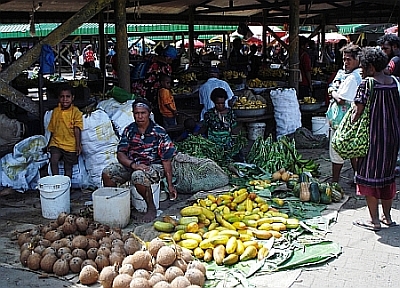
Bire Nikil moved to Port Moresby from Chimbu Province in the highlands to start a food garden several years ago. At Gordons Market, he is surrounded by five of his relatives who assist him with growing and selling kaukau (sweet potato), bananas, aibika (Pacific cabbage), pineapples, peanuts, watermelon, mangoes and coconuts, all transported in by public minibus. Nikil’s weekly income of K300 (142 dollars) supports 20-25 people, including relatives in Chimbu province.I love Papua New Guinea's policy statement that the informal economy constitutes "the grassroots expression" of the private sector.
Sunday, January 22, 2012
the most potent symbol of the year gone by

The hunt for scrap and the miles that these people walk every day to get it, is not shown in any economical transaction, no invoices are kept, no receipts are issued, just warm, black money is flowing not only to the lower levels of the system but also at the later stages of the reselling process. For the smallest junkyard to the biggest, again no records are being kept, the paperwork is barely typical, while at the same time, there is a million-euro turnover that reaches up to the steel industry. We are talking about huge sums of money, the material prices skyrocket from the time the collectors turn them over to the moment they reach the industrial melting pot to be further used again in constructions. The story is not simple at all, and it bears no relation to what comes out as an image.But it's also how people survive and thrive in hard times.
Friday, January 20, 2012
The Yippie Way of Ownership
The whole whoopee cushion of words over the Stop Online Piracy Act and the Protect Intellectual Property Act got me thinking about Abbie Hoffman and Jerry Rubin.
Those two were the most pop-culture-savvy leaders of the group of agitprop rebels who promoted ‘free’ as a lifestyle a generation ago—the Yippies. But, even for them, it was not easy to say exactly what free meant.
Abbie’s first publication, a 1967 pamphlet called Fuck the System, proudly proclaimed the principle of free and open access: “Nothing in this manual is copyrighted. Anyone may reprint this information without permission. If you paid money for this manual you got screwed. It’s absolutely free because it’s yours. Think about it.” (Abbie later disclosed that, through a middleman, the government of New York City had actually paid the printing costs—proving that, then as now, ‘free’ sometimes requires that somebody else pick up the tab.)
In 1968, a year after Fuck the System came out, Abbie published Revolution for the Hell of it. He dedicated the book to “FREE.” He published the book under the pseudonym ‘Free.’ But the book wasn’t free: the hardcover price was $4.95 and the copyright was held by The Dial Press.
When Abbie published his 1971 primer on the art of getting stuff for free, he called it Steal This Book—but he didn’t really want readers to steal it. How do I know? Because he copyrighted Steal This Book in the name of Pirate Editions. Why copyright a book that tells you how to get things for free? Because Abbie was accused of piracy himself. His collaborator and all-around researcher, Izak Haber, called him out for stealing the work without compensation. (Though Haber is acknowledged in the book as a co-conspirator, he didn't feel that was enough, and you can read his account, “An American Dream: A True Yippie’s Sentimental Education or How Abbie Hoffman Won my Heart & Stole ‘Steal This Book,'” in Rolling Stone magazine of September 30, 1971.) Copyrighting the book in the name of Pirate Editions hid the fact that Hoffman had been forced to give Haber a cut of the profits.
When Abbie published his 1971 primer on the art of getting stuff for free, he called it Steal This Book—but he didn’t really want readers to steal it. How do I know? Because he copyrighted Steal This Book in the name of Pirate Editions. Why copyright a book that tells you how to get things for free? Because Abbie was accused of piracy himself. His collaborator and all-around researcher, Izak Haber, called him out for stealing the work without compensation. (Though Haber is acknowledged in the book as a co-conspirator, he didn't feel that was enough, and you can read his account, “An American Dream: A True Yippie’s Sentimental Education or How Abbie Hoffman Won my Heart & Stole ‘Steal This Book,'” in Rolling Stone magazine of September 30, 1971.) Copyrighting the book in the name of Pirate Editions hid the fact that Hoffman had been forced to give Haber a cut of the profits.
Jerry, meanwhile, offered his own spin on ‘free.’ “Money is Shit,” he opined in his 1970 tome Do It! “Money is a drug, Amerika is a drug culture, a nation of crazy addicts….Burning money (and credit cards and banks and property) is an act of love, an act on behalf of humanity,” In Yippieland, he preached, “there will be no such crime as “stealing” because everything will be free.” Rubin acknowledged his collaborators on the title page, noting the book was “Yipped by Jim Retherford” and “Zapped by Nancy Kurshan.” Do It! was copyrighted, though, in the name of the Social Education Foundation—a non-profit. Who could possibly be against Social Education? The Internal Revenue Service, that’s who. One year after the book came out, the feds revoked the tax-free designation, asserting the only charitable work the foundation did was to funnel money to a single truly needy fellow named Jerry Rubin.
So how do Abbie and Jerry shed light on SOPA and PIPA? This way: Abbie and Jerry were right that free is a great and desirable and valuable thing. But they were also chameleons. They advocated ‘free’ when free suited them. And they advocated pay when pay was to their benefit.
This is one of the points that Jaron Lanier made in a New York Times Op-Ed on Thursday. Lanier suggested that we’ve become linear in thinking about these issues rather than acknowledging that copyright and copyleft are both a mixed bag. Addiction to copyright puts big bucks in the hands of big corporations like the ones that make and distribute movies. But copyleft—which offers free usage—puts the big bucks in the hands of big companies that assemble private data and aggregate eyeballs to sell advertising. It’s the bad guys fighting the bad guys. “We in Silicon Valley undermined copyright to make commerce more about services than content—more about our code than their files,” Lanier wrote. “The inevitable endgame was always that we would lose control of our own personal content, our own files.” Translation: we're all fucked.
But, as the money being spent on this battle shows, there are some who aren't fucked. A lot of people say the web is like a commons. Maybe. But it’s a commons where a select cadre of companies are making tons of money.
But, as the money being spent on this battle shows, there are some who aren't fucked. A lot of people say the web is like a commons. Maybe. But it’s a commons where a select cadre of companies are making tons of money.
SOPA and PIPA are apparently no longer being fast-tracked, but the brouhaha is still simmering. The New York Times reports that the Motion Picture Association of America—one of the most ardent supporters of the bills—now wants to sit down with the tech companies, perhaps at the White House. At the same time, the government has upped the stakes by taking down Megaupload, one of the ‘locker services’ that allows users to upload unrestricted content (interestingly, Megaupload recently settled a copyright infringement lawsuit brought against it by the porn studio Perfect 10—though the terms of the settlement were not revealed.) The feds claimed that Megaupload was profiting massively from its position as a drop box for piracy and asserted in the indictment that the firm and its owners and subsidiaries had more than $175 million in cash stashed in 64 accounts in banks around the world. (BTW: can anyone tell me how the government has the standing to bring a case of copyright infringement? And how the government can shutter megaupload without having proved that the company’s done something wrong?)
I confess. Stealth of Nations has a small c in a circle with my name next to it on the back side of the title page. This may seem odd in a book that extols certain kinds of piracy. Indeed, I once owned a well-thumbed copy of Steal this Book—until a friend borrowed it for good. And when Yipster Times, the Yippie paper, published the calling card numbers of various federal agencies and massive corporations, I sometimes used them to make cross-country calls. Charging it to The Man. At the time, nothing felt freer.
Still, I’m glad that that little symbol is in my book. Not because it prevents piracy. Rather, I see it as a printed reminder of a labor of love that consumed years of my life. I trust that people will honor that--that other publishers won’t use my words without my permission and will include my name when they cite stuff I reported. Yes, I want people to buy my book. But the truth is that I can only wish that Stealth of Nations gets pirated and winds up on a site like Megaupload. That would mean it was a success, that it had reached a truly wide audience--and, since nothing will get pirated if there isn't demand for it, that I had made enough money on it that I didn’t need to worry about the lost revenue.
SOPA and PIPA are ugly blunt instruments that will limit free speech and have impacts far beyond the realm of copyright. But we can’t trust Google or Wikipedia to fight this battle either. Indeed, just thinking about Chris Dodd and Sergey Brin sitting down in a room with Obama’s Chief of Staff Jacob Lew and banging out a deal is bone-chilling.
Is there a lesson in all this? Perhaps it’s this: Don’t trust anyone under 40. Don’t trust anyone over 40. And don’t mess with Mr. In-between. Or, as Frank Mankiewicz told Hunter S. Thompson in Fear and Loathing on the Campaign Trail '72: “Keep your own counsel. Don’t draw any conclusions from anything you see or hear.”
Yippie!
Yippie!
Subscribe to:
Posts (Atom)